
What Is Composite Deck Made Of? A Simple Breakdown for Homeowners
If you’re planning an outdoor space and comparing decking options, one of the first questions that usually comes up is ‘what is composite decking made of?’. Understanding the materials behind composite decking makes it much easier to see why it performs differently from traditional timber decking and why it has become such a popular choice for modern homes.
In this guide, we break down what goes into a composite deck, how those materials work together, and how EnviroBuild’s two fantastic composite decking ranges are designed to deliver durability, consistency, and low maintenance.

Author Name
Chief Writer
Thu, 28 Jul 2026
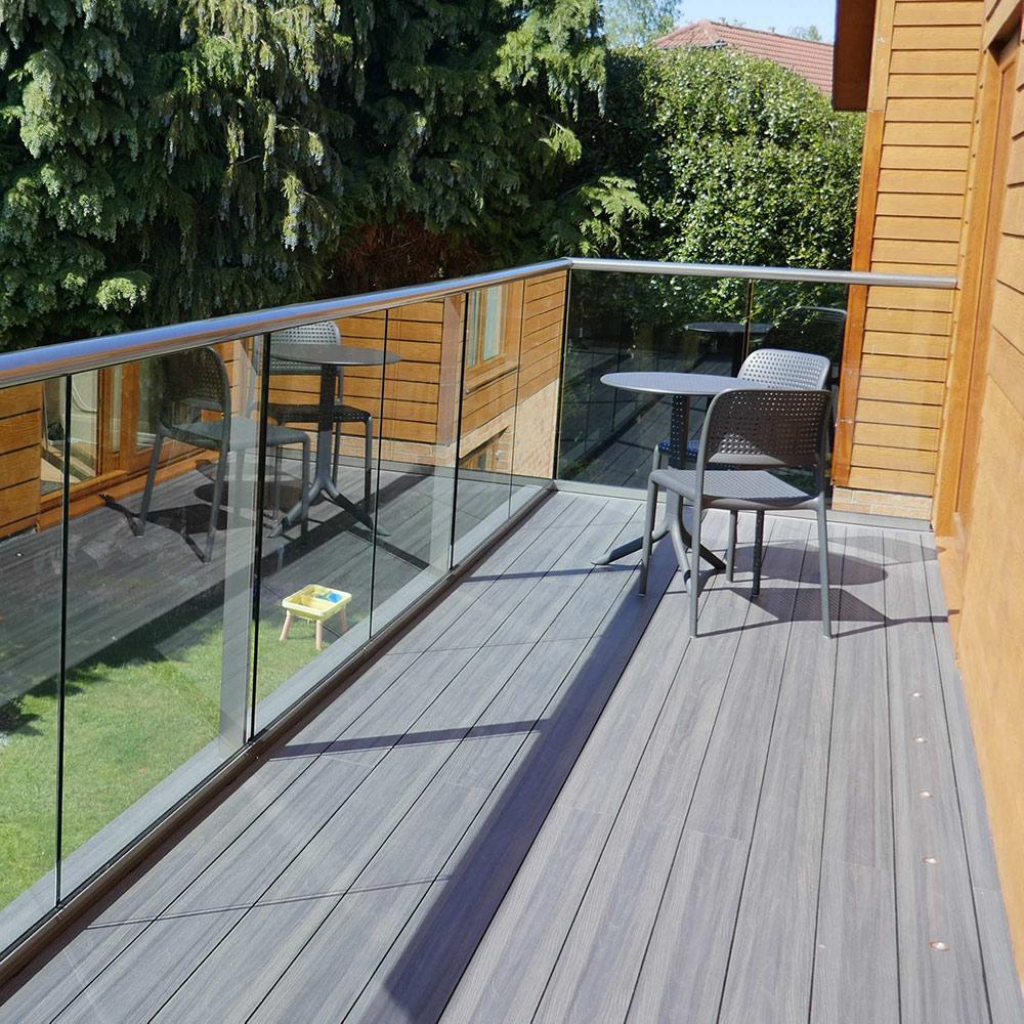
What Is Composite Decking Made Of?
Composite decking is made from wood-plastic composite (WPC): a blend of roughly 50–60% recycled or reclaimed wood fibre and 30–40% recycled HDPE or polypropylene plastic, bound together with coupling agents, UV stabilisers, colour pigments and lubricants. The mix is heated and extruded into board profiles, sometimes finished with a protective plastic “cap” layer for extra weather resistance.
At a Glance
Attribute
Typical Detail
Wood fibre content
~50–60% (recycled/reclaimed sawdust, wood flour, or FSC-certified fibre)
Plastic content
~30–40% (recycled HDPE or polypropylene most common; PVC used by some brands)
Additives
1–13% — coupling agents, UV stabilisers, pigments, lubricants, sometimes biocides
Manufacturing method
Extrusion (single or twin-screw), often with a co-extruded cap layer
Board types
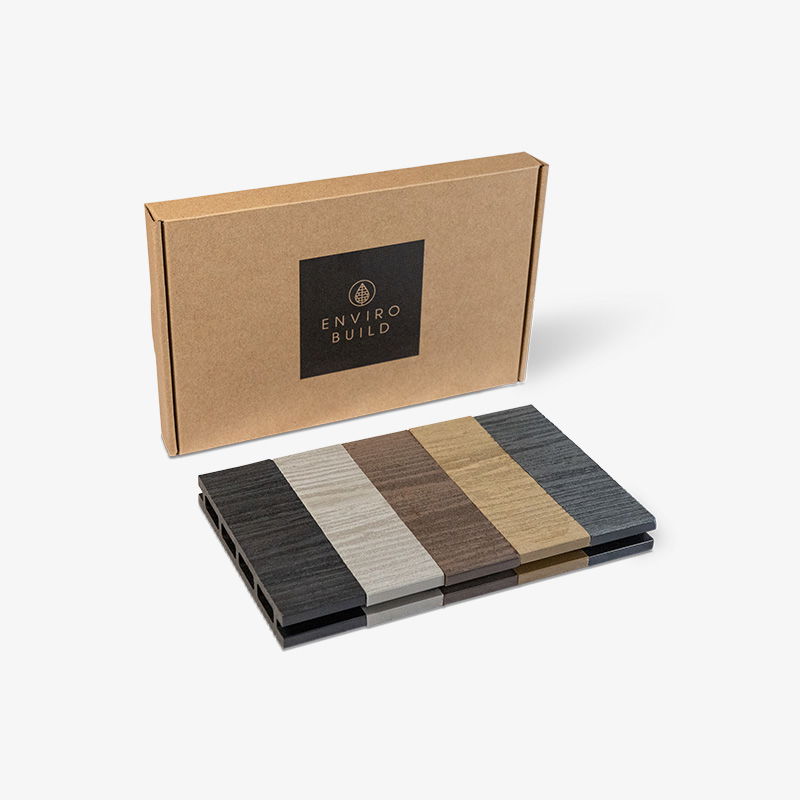
Capped or uncapped; solid-core or hollow-core
Relevant standard
BS EN 15534 series (WPC decking profiles and tiles)
Density
Roughly 1.0–1.4 g/cm³ — denser than solid softwood decking
EnviroBuild example
Explorer decking: ~57% FSC-certified eucalyptus wood fibre + 30% recycled HDPE + bonding agent, additives and tint (per EnviroBuild’s published Environmental Product Declaration)
What is composite decking actually made of?
Composite decking — technically a wood-plastic composite, or WPC — is not a single material but an engineered blend of three ingredient groups:
Wood fibre: Sawdust, wood flour, or reclaimed timber offcuts, typically from sawmill waste or FSC-certified sources
Plastic: Most commonly recycled high-density polyethylene (HDPE), though polypropylene (PP) and, less often, PVC are also used.
Additives: A small but functionally important fraction, including coupling agents, UV stabilisers, colour pigments, lubricants, and sometimes biocides or fire retardants
Industry material-science literature generally puts standard WPC formulations at close to a 50:50 wood-to-plastic split by weight, though many decking-specific products now lean higher on wood fibre — commonly in the 55–60% range — with plastic making up roughly 30–40% and additives accounting for the remainder [1][2]. EnviroBuild’s own published Environmental Product Declaration (EPD) for its Explorer decking range states a composition of around 57% FSC-certified eucalyptus wood fibre and 30% recycled HDPE, with the balance made up of a bonding agent, additives and tint [7]. You can see full board specifications on our composite decking range page.
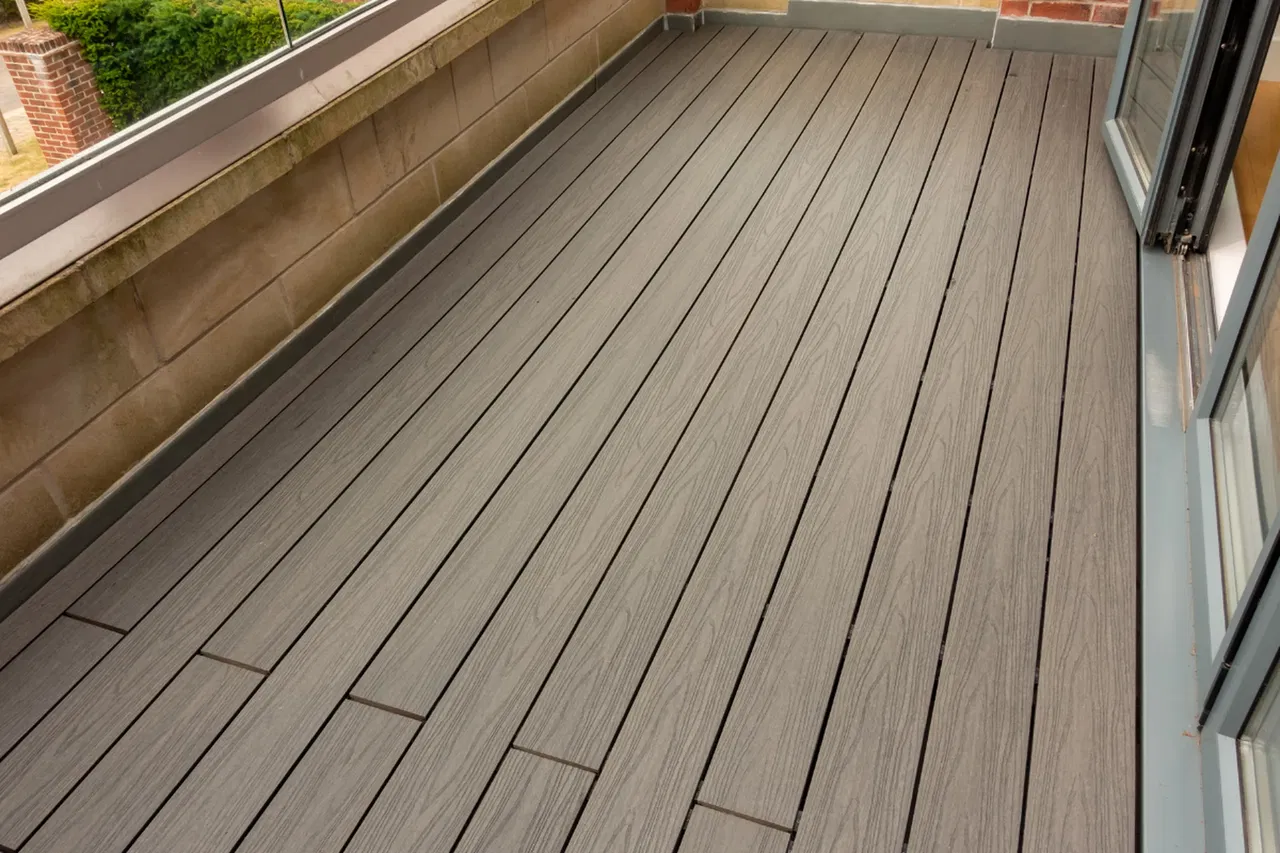
What percentage of composite decking is plastic?
In most WPC decking boards, plastic accounts for roughly 30–40% of the total mass, with wood fibre making up the majority (50–60%) and additives filling the rest. This varies by manufacturer and product line — some “high-performance” or capped boards increase the plastic fraction (or add a plastic-rich cap layer) specifically to improve moisture resistance, since the plastic component is what keeps water away from the wood fibres.
The plastic matrix does most of the structural “sealing” work: because thermoplastic resins like HDPE are hydrophobic, the plastic encases the wood particles and limits how much moisture the fibres can absorb, which in turn reduces swelling, warping and rot compared to solid timber [2][3].
Why is wood fibre added at all, if plastic performs better in moisture?
Plastic alone would be cheaper to keep dry, but pure plastic boards feel and behave very differently underfoot — they flex more with temperature, have a plastic sheen rather than a timber look, and (being a fossil-fuel derived resin at high volumes) carry a different environmental profile. Wood fibre is added because it:
Gives the board a natural, timber-like texture and appearance
Improves grip underfoot compared to smooth plastic
Adds stiffness and reduces thermal expansion relative to 100% plastic boards
Allows manufacturers to use recycled/reclaimed wood waste rather than virgin material
The trade-off is that wood fibre is the component most vulnerable to moisture and UV-driven fading, which is why manufacturing technique (capping, coupling agents) matters so much for long-term performance [3][4].
How is composite decking manufactured?
Most WPC decking is made through extrusion: wood fibre and plastic pellets (often pre-compounded) are blended with additives, heated to a semi-molten state, and forced continuously through a shaped die to form the board profile. The extruded profile is then cooled — typically in a water bath or spray chamber — embossed with a wood-grain texture, and cut to length [3][4].
Two manufacturing variations matter most for buyers:
Single vs co-extrusion:
In single extrusion, the wood-plastic blend forms the entire board and is exposed on all faces (uncapped). In co-extrusion, a second, thinner layer of near-pure (often wood-fibre-free) plastic is fused around the core in the same pass, forming a protective “cap”, this gives the board additional durability and moisture resistance.
Solid vs hollow-core profiles:
Boards can be extruded as a solid rectangular profile or with internal hollow chambers running along their length. Hollow-core boards use less material and weigh less, which reduces cost and eases handling, but solid-core boards generally offer higher load-bearing capacity, better screw-holding strength, and are less prone to structural failure under a mechanical fastener [5][6].
What is a capped composite board?
A capped composite board has a thin plastic shell — usually made of the same base plastic (HDPE or PP) blended with additional UV stabilisers and pigments — fused around the wood-plastic core during manufacturing. This cap is usually applied to some or all faces of the board, though “fully capped” boards wrap the cap around all four sides.
Because the cap layer contains little or no wood fibre, it is far more resistant to moisture ingress, staining and UV fading than the composite core underneath. This is the main reason capped boards typically carry longer warranties (commonly 20–25 years) than uncapped boards (commonly 10–15 years) [4][5]. The trade-off is cost: capped boards generally cost more to manufacture than uncapped equivalents, since they require a second extrusion layer and additional plastic.
Uncapped boards expose the wood-plastic blend directly, which means the wood fibre grain is visible and tactile on the surface (some buyers prefer this more “timber-like” texture), but the exposed wood fibre is more susceptible to moisture absorption, surface fading, and staining over time than a capped equivalent.
For a closer look at how these choices play out across our ranges, see our full guide to types of composite decking.
How does composition affect strength, weight and moisture absorption?
The ratio and quality of the three ingredient groups directly determines how a board performs:
Density and weight
WPC decking is generally denser than kiln-dried softwood decking because the plastic fills the cellular voids that make natural wood relatively light. Typical composite boards run in the region of 1.0–1.4 g/cm³, and full composite deck boards are commonly cited as 20–30% heavier than equivalent solid wood boards [6]. A higher plastic ratio, or a hollow rather than solid profile, can reduce this weight somewhat.
Moisture absorption
Because plastic is hydrophobic and wood fibre is not, the plastic-to-wood ratio (and whether the board is capped) is the single biggest factor in how much water a board will take on. Higher plastic content, full capping, and coupling agents that improve the wood-plastic bond all reduce water uptake, swelling and the risk of mould or rot [2][3][4].
Mechanical strength
Wood fibre contributes stiffness, while the plastic matrix contributes flexibility and moisture resistance; coupling agents (added at roughly 1–8% of the wood fibre weight in typical formulations) chemically bond the two so the composite behaves as a single material rather than a loose mixture, improving flexural strength and reducing the risk of delamination [2][6].
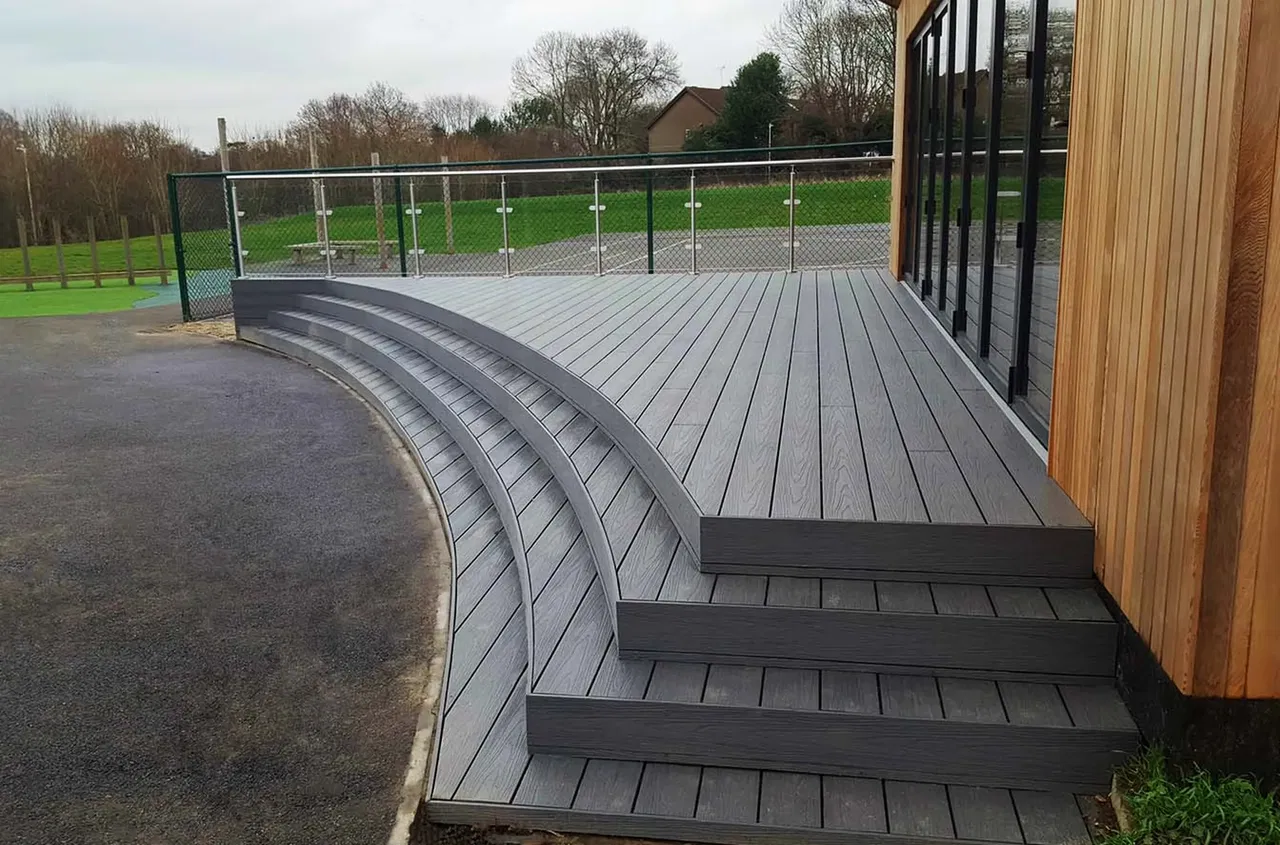
Composite decking vs solid wood vs PVC/uPVC decking
At a material level, here's how the three most common decking types compare — for a fuller breakdown of the wood side of this comparison, see our wood vs composite decking guide.
Property
Composite (WPC) decking
Solid wood decking
PVC / uPVC decking
Core material
~50–60% wood fibre + ~30–40% recycled plastic + additives
100% natural timber
~100% plastic (unplasticised PVC), no wood fibre
Manufacturing
Extrusion, often co-extruded with a cap layer
Sawn and milled from timber
Extrusion or moulding of PVC resin
Relative weight
Heavier than wood (~20–30%); lighter than nothing
Lightest of the three, but varies by species/moisture
Generally lightest of the manufactured options
Moisture absorption
Low-moderate (lower if capped)
High — prone to swelling, warping, rot if untreated
Very low — essentially non-porous
UV fading
Low-moderate (lower if capped)
Greys/fades naturally, needs re-staining
Low, but can show more thermal expansion
Thermal expansion/contraction
Low
Moderate (with moisture cycles)
Can be significant in high heat
Maintenance
Low (occasional cleaning)
High (sanding, staining, sealing)
Low
Typical relevant standard
BS EN 15534 series
National timber grading standards
Product-specific manufacturer standards
What standards apply to composite decking?
In Europe and the UK, wood-plastic composite decking is covered by the BS EN 15534 series (“Composites made from cellulose-based materials and thermoplastics — usually called wood-polymer composites (WPC) or natural fibre composites (NFC)”), with BS EN 15534-4 specifically addressing decking profiles and tiles. This standard sets out test methods and performance requirements rather than mandating a specific composition — covering areas such as flexural strength and modulus, impact resistance, load-bearing capacity, fastener retention, water absorption and dimensional stability [8]. It does not prescribe a required wood-to-plastic ratio; that formulation choice is down to each manufacturer, which is why composition and performance can vary meaningfully between brands even though they may reference the same standard.
Frequently Asked Questions
Is composite decking mostly plastic or mostly wood?
By weight, most composite decking is mostly wood fibre — commonly 50–60% — with recycled plastic making up roughly 30–40% and additives accounting for the rest. The exact ratio varies by manufacturer and product range.
Is composite decking waterproof?
No composite decking is fully waterproof, but well-formulated boards — particularly capped ones — absorb very little water compared with solid timber, because the plastic component and any cap layer largely shield the wood fibre from moisture.
Does composite decking contain real wood?
Yes. Standard WPC composite decking contains genuine wood fibre, typically recycled or reclaimed sawdust, wood flour, or FSC-certified timber offcuts, blended with plastic — it is not a purely synthetic product (unlike PVC/uPVC decking).
What plastic is used in composite decking?
Recycled high-density polyethylene (HDPE) is the most common plastic used in composite decking, though polypropylene (PP) is also widely used, and a small number of products use PVC.
Is capped composite decking worth the extra cost?
Capped boards generally cost more but offer better resistance to moisture, staining and UV fading, which typically translates into longer manufacturer warranties. Whether it’s “worth it” depends on budget, exposure conditions, and how much maintenance you’re willing to do.
Is composite decking recyclable?
Composite decking is often made from recycled wood and plastic content to begin with. Whether the finished board itself can be recycled at end of life depends on the manufacturer’s take-back schemes and local recycling infrastructure for mixed wood-plastic materials, since WPC is harder to separate into pure streams than single-material products.